Candidate scorecard comparison
Compare candidates objectively, side by side. Every Gaugely interview produces a structured scorecard — the same rubric, every candidate, every score backed by quoted evidence. The comparison view lines them up across every competency so you pick on signal, not gut. Structured interviews predict job performance far better than unstructured ones.
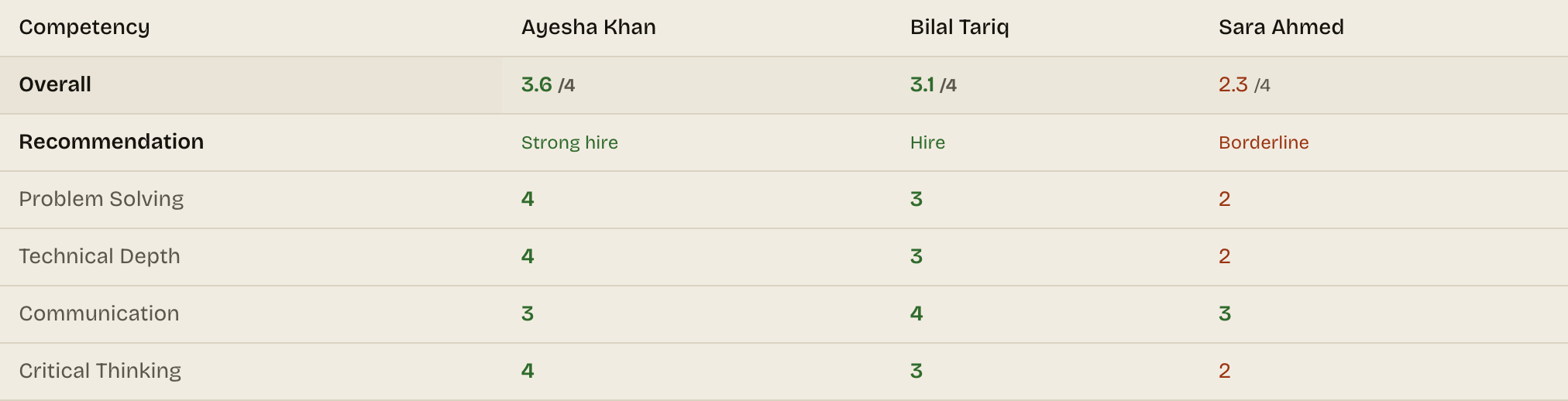
- →Side-by-side matrix of every competency the interviews tested
- →Each score cites the candidate's own words — evidence, not vibes
- →The same bar for candidate #1 and #400 — no fatigue or order bias
- →A human always makes the final call (EU AI-Act-ready, no auto-rejection)
Gaugely closes the loop: screen CVs → interview the best (voice or video) → compare scorecards → re-engage your past top candidates. No other tool feeds your own interview signal back into screening.
Questions
How do I compare interview candidates objectively?
Gaugely scores every candidate on the same competencies with quoted evidence, then shows them side by side in a comparison view — so you decide on consistent signal instead of memory or gut feel.
Are the scores consistent across candidates?
Yes. Every candidate is asked the same questions and scored against the same rubric, with each score linked to what they actually said — removing the fatigue and order bias of manual phone screens.
What is a screening scorecard?
A screening scorecard is a fixed set of competencies every candidate is rated against, with evidence attached to each rating. It replaces free-text interview notes, which are hard to compare, with a grid you can sort — the same standard applied to the first candidate and the four-hundredth.
Can I customize the evaluation criteria?
Yes. You define the competencies and the rubric per job, and Gaugely scores against yours rather than a fixed template. Questions are tagged to the competency they assess, so the scorecard only reports on what the interview actually tested.